
Inglewood City Directory Collections: Historical Holdings
The local directory collections in Los Angeles County have several different levels of certainty. A digitized 1929 volume is inspectable online through Google Books and identifies itself as an Inglewood directory from the New York Public Library. Genealogy catalogs, including the FamilySearch Los Angeles County catalog route, identify a 1927 through 1935 run, but a catalog reference is not the same as guaranteed full-text access. Inglewood Public Library confirms three Haines reverse directories for areas around Inglewood, while the exact editions and years need a staff check.
| Collection | Years | Where Held | Access |
|---|---|---|---|
| Inglewood city directory | 1929 confirmed | Google Books scan from New York Public Library | Free online inspection |
| Inglewood city directories | 1927-1935 cataloged | Genealogy catalogs, including FamilySearch references | Verify volume access before relying on a year |
| Haines criss-cross directories | Three editions; years not published | Inglewood Public Library | Staff-assisted or in person |
| Los Angeles city directories | 1922, 1924, 1926, 1928, 1930 to an endpoint to verify | Reported at Inglewood Public Library | Ask Adult Services for the complete run |
| LA Street Address Directories | 1956, 1960-1965, 1967-1969, 1973 | Reported at Inglewood Library | Address-first local context |
| Historical photographs | Circa 1800-2008 | Inglewood Library and OAC | Finding aid and rights check |
| Sanborn maps | February 1912, 13 sheets | Library of Congress | Free digitized images |
The sequence starts with the 1912 landscape, then moves through the cataloged run, later address directories, and the photo archive. A spine year is a lead, not proof that every Inglewood household appears.
Note: The 1929 scan is confirmed, while the broader run still needs catalog and library checks.
Inside the 1929 Inglewood City Directory
The confirmed 1929 Inglewood volume is valuable because it supplies a real local entry model. Alphabetical headings use surname followed by given name or initial. A spouse may appear in parentheses, and “wid” can signal a widow followed by a deceased spouse’s given name. An occupation follows in abbreviated form, while “h” commonly precedes a home address. Business entries can add a firm, category, street address, or telephone.
Searchable vocabulary includes auto mechanic, bookkeeper, carpenter, chauffeur, gardener, machinist, plumber, painter, salesman, and stenographer. Local street tokens include Acacia, Arbor Vitae, Centinela, Eucalyptus, Fairview, Grevillea, Manchester, Market, Regent, and York. Street words help split people with the same name.
The digitized 1929 volume should be read with its own abbreviation key. “r” may mean resides, rooms, or rear depending on the publisher. “bds” and spouse marks need the volume’s explanation. Directory inclusion reflects a canvass and publication date, not every day of the calendar year.
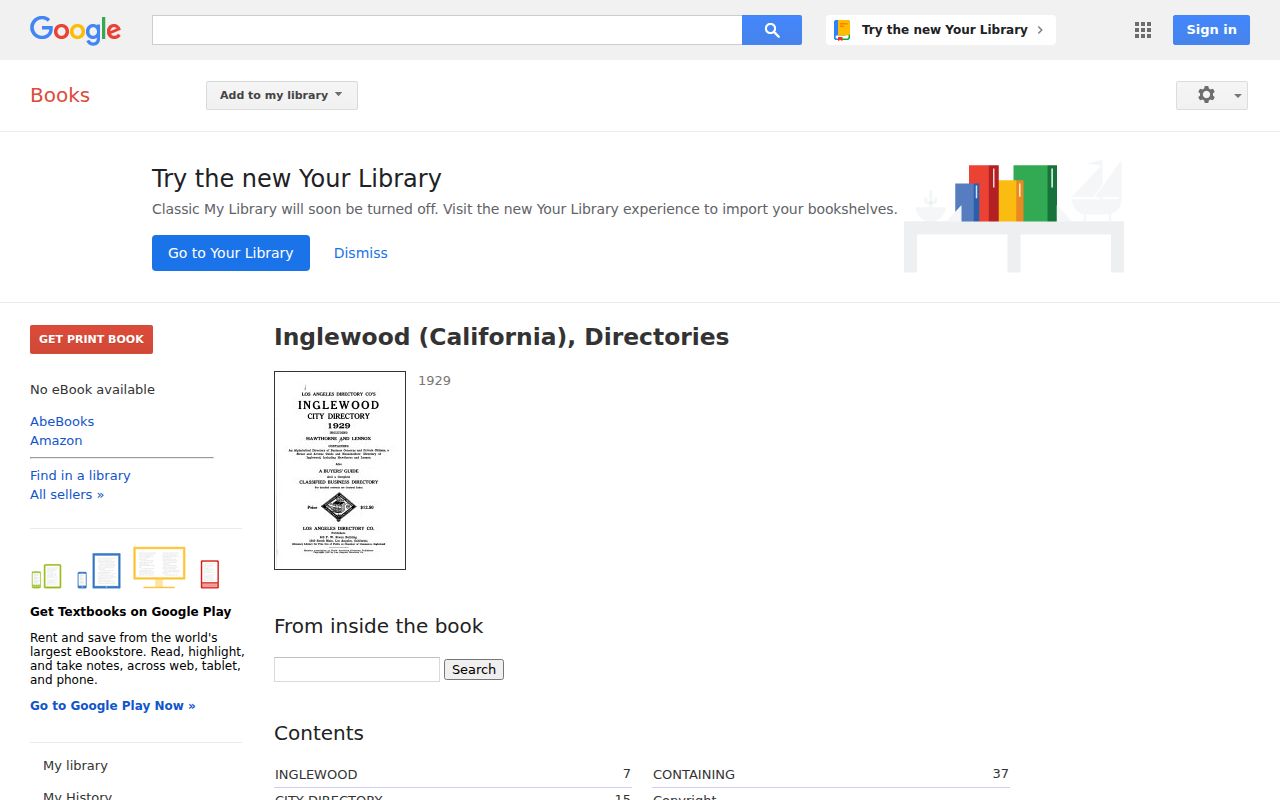
The digitized-directory image shows why the original page and key matter more than a modern transcription alone.
- Householder index
- An address-oriented finding aid that connects a street or household entry to a name when the publisher supplies one.
- Abbreviation key
- The publisher’s explanation of short marks such as h, r, bds, or widow notation.
- Criss-cross directory
- An address or telephone section that moves from place to listed subscriber rather than from surname to place.
Inglewood City Directory: Three Haines Editions
The Inglewood Public Library Haines FAQ confirms three Haines directories covering areas around Inglewood. Haines is the address-first counterpart to an alphabetical city directory. Start with a street number or telephone number, read the listed subscriber, and then test the name in an alphabetical volume. This is especially useful when a family is known by a house but not by a complete surname.
The library does not publish the exact Haines years on the FAQ page. Ask Adult Services which editions are on hand, whether the search is self-guided or staff-assisted, and whether a telephone number can be searched. Do not turn “three directories” into an invented year run. The honest date gap is part of the collection description.
Read nearby entries in sequence. The street section can show number order and neighbor context, but it represents subscribers, not every household member. A Haines hit is a dated lead that should be paired with another record.
The city’s historical-resource pages also point researchers toward local-history help when a directory clue needs family or neighborhood context.
Note: Confirm the Haines edition and year with Adult Services before citing a reverse-directory result as dated evidence.
Reading an Inglewood City Directory Entry
Read an entry from left to right, then copy it exactly before interpreting it. Start with the surname and given name. Note an initial, spouse or widow mark, occupation, work label if printed, address, and any telephone or business line. A house abbreviation usually marks a home address, but the volume key controls. A business listing may describe a firm at an address without placing its owner there.
Names change shape across a run. Compound surnames, maternal and paternal surname order, omitted diacritics, married names, initials, and anglicized spellings can all affect a search. Try a surname variant, then confirm the street, occupation, spouse, or house number. Never infer identity from a surname alone.
| Entry part | Question to ask |
|---|---|
| Name heading | Is this the same given name or initial, with the same surname form? |
| Spouse or household clue | Do parentheses or widow notation connect the entry to a family line? |
| Occupation | Does the work clue separate two people with the same name? |
| Address after the home mark | Is the street and number consistent with the map and other years? |
| Owner or renter mark | Use a mark only when the volume key defines it; do not assume every edition has one. |
| Business line or advertisement | Does it show a public firm rather than a private household? |
A directory entry is an index to a moment. It can show a listed resident, an occupation, or a move between editions. It cannot establish present residence or legal title without a separate source.
Inglewood City Directory: Pair With 1930 Census
The strongest household method pairs a directory with a census year. Start in the 1929 volume and write down the entry exactly. Check an earlier and later edition to narrow a move interval. Then compare the household in the 1930 federal census, using the address, enumeration district, surname variants, age, relationship, birthplace, occupation, and owner or renter field. A census schedule can add household structure that a directory does not print.
- Copy the 1929 name, spouse clue, occupation, address, and abbreviation before searching variants.
- Check the nearest available directory year on each side and mark an address change or disappearance.
- Use enumeration-district maps and street order to match the 1930 household, not a name alone.
- Compare the building and lot with the 1912 Sanborn sheet when an older structure is involved.
- Use probate, an obituary, or a later directory to test what happened after the census.
The federal census is open through 1950 under the 72-year release rule, and 1960 schedules are scheduled for release in 2032. Most 1890 schedules were destroyed, so directories, newspapers, and other local sources bridge that decade.
Name the source for each fact: a directory lists a person at publication time, while a census records an enumerator’s household snapshot. That distinction keeps the search useful without making it claim more than it can.
Tracing Families Through Inglewood City Directories
For family history, move in small steps across the run. Use the name-first alphabetical section for the starting person, then use the address-first Haines section to inspect nearby numbers. A change in street can suggest a move interval. A disappearance can mean relocation, death, nonresponse, name change, or an omitted listing. Mark each possibility instead of choosing one from the gap.
When a person dies or vanishes from a directory, follow the record type that fits. Newspapers, cemetery material, a death certificate, and probate may connect the household to heirs. An old classmate may be found through yearbooks, alumni files, and local library collections. These sources help explain a gap without forcing a historical directory to answer a present-day question.
Keep a four-part historical note for each stop: edition year, page, street form, and source date. That record preserves the difference between a printed clue and a later conclusion, and it makes a correction possible when two people share a name.
1912 Sanborn Before Inglewood City Directory
The February 1912 Sanborn map set supplies the built landscape just after Inglewood incorporated in 1908. The digitized set contains 13 sheets. It can show a structure’s footprint, use, material, lot context, street name, and early number. It cannot name every person in the building, so it belongs beside a directory, census, or newspaper source rather than in place of one.
Use the index sheet and cross streets to select the right page. Compare the old footprint with the directory's street words and the census enumeration district, then preserve the sheet and page in your notes. This helps when a later listing uses an older street form or when a building's history spans several volumes. A building’s presence in 1912 is evidence of the built site, not proof that a later household occupied it.
The Library of Congress Inglewood Sanborn item provides the free map images. Read it beside the 1929 volume and later library holdings so the map adds place context without replacing the directory evidence.
Inglewood Photos and Centinela Valley Memory
Inglewood Public Library’s local-history photograph collection spans roughly 1800 through 2008 and is described in an Online Archive of California finding aid. Photographs can place a building, school, business, street scene, civic group, or event in time. They can also supply a surname or organization to test in the directory. The finding aid and rights terms should be read before reuse.
The Historical Society of the Centinela Valley and Centinela Adobe maintain a library built heavily from founding-family donations, with California, aviation, and local-history holdings. Ask about surname files, property photographs, organizational records, maps, clippings, and appointment conditions. Aviation material is especially local to Inglewood’s regional history and can connect a family or business to an institution without exposing a private address.
The OAC finding aid is the correct starting point for collection scope.
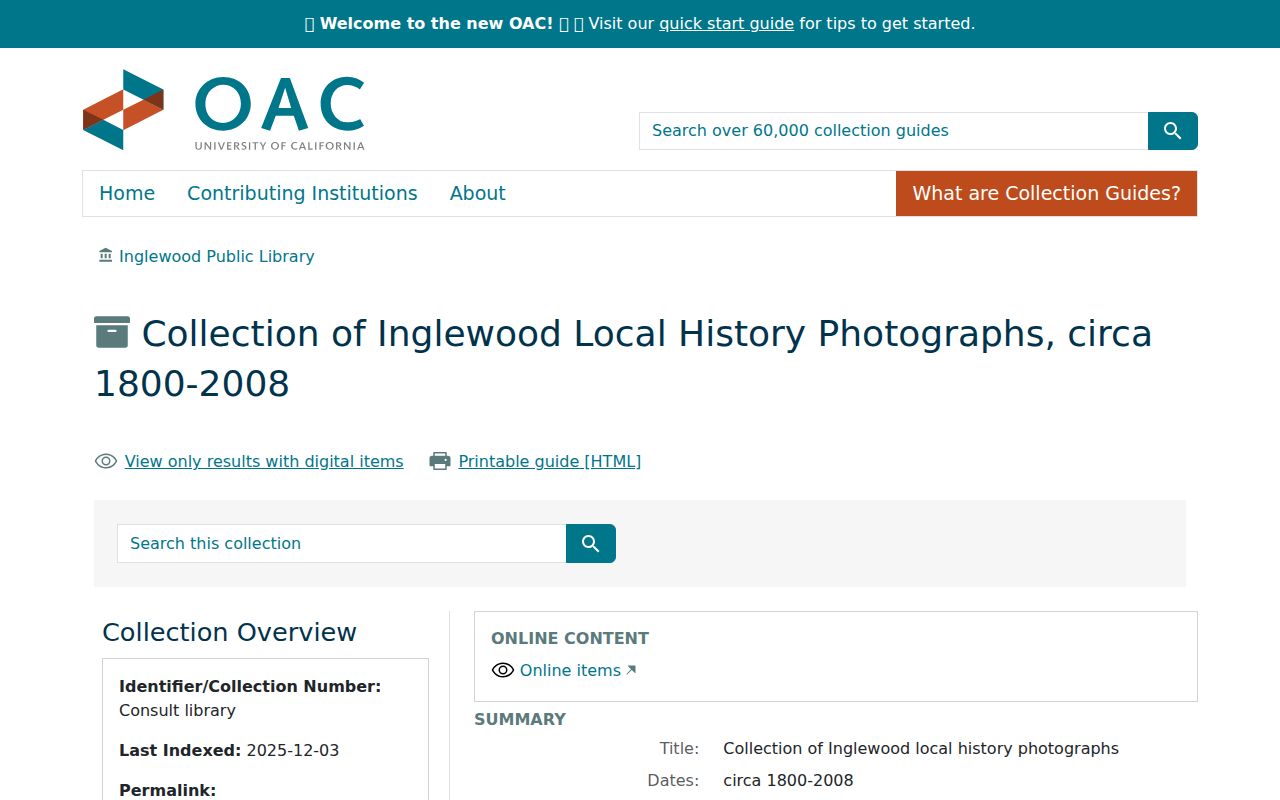
The photograph-collection image represents the archive layer that can enrich a directory entry with place and community context.
The Historical Society of the Centinela Valley page identifies the local research library represented in the next image.
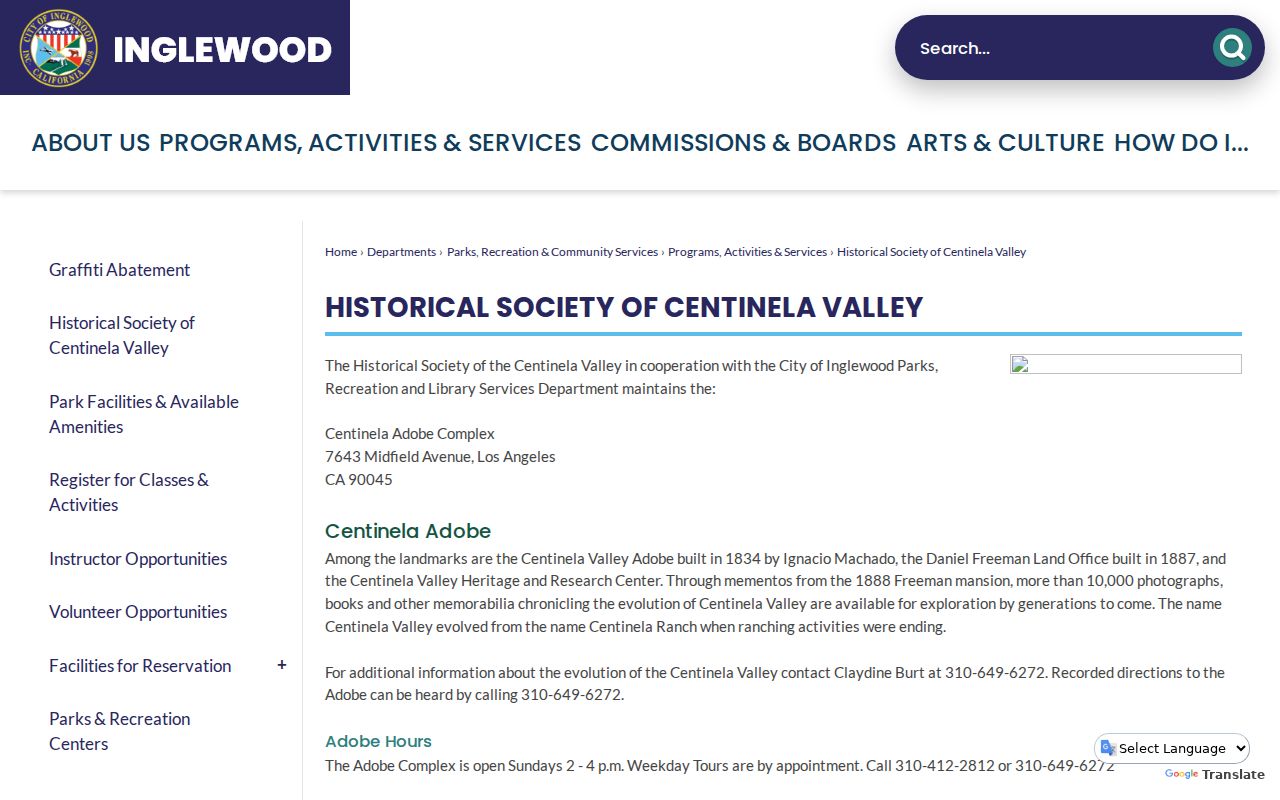
The Historical Society image points to the local research library, where a directory clue can be checked against donated family and community material.
Note: Confirm appointment and reproduction rules with the Historical Society before planning an archive visit.
Missing Inglewood City Directory Entry
A blank year is not a move notice. A directory may omit a household, use a spouse or widow convention, list a business instead of a home, or cover an area unevenly. Haines editions have their own coverage and subscriber limits. The library has not published a complete obituary-index title or exhaustive year-by-year shelf list, so ask Adult Services before promising a run.
Use substitute evidence in layers. The 1930 or another available census can test the household. A newspaper can place an event. Probate or cemetery material can add a family endpoint. The Sanborn map can test whether the building existed. Each source has a keeper and a date; the absence of one entry does not cancel the others.
The best city directory work is patient and local. It treats the 1929 volume as a real primary object, Haines as a reverse finding aid, the census as a household snapshot, and the Historical Society as a context archive.